Last updated:2026-10-12
STL array source code analysis
0.Introduction
The source code analysis is based on gcc4.9.1.
C++ tr1, fully named Technical Report 1, is the first extension to the C++ standard library. The C++ standard c++0x would include it, along with some extensions to the language itself. tr1 includes the long-awaited smart pointers, regular expressions, and other content supporting generic programming. During the draft stage, the namespace for the newly added classes and templates was std::tr1.
1.std::tr1::array
Usage:
The array in tr1 is fairly simple: it mimics the language's built-in arrays and makes them support iterator operations, so that like other containers it can be used with algorithms. In tr1, array has no constructor or destructor. The iterator is simply a pointer defined using the passed-in type.
Let's take a quick look at the source code of this static array:
template<typename _Tp, std::size_t _Nm>
struct array
{
    typedef _Tp                           value_type;
    typedef value_type&                           reference;
    typedef const value_type&                     const_reference;
    typedef value_type*                       iterator;
    typedef const value_type*                 const_iterator;
    typedef std::size_t                           size_type;
    typedef std::ptrdiff_t                         difference_type;
    typedef std::reverse_iterator<iterator>       reverse_iterator;
    typedef std::reverse_iterator<const_iterator>   const_reverse_iterator;
}
reverse_iterator as the iterator for the rbegin and rend operations.
It looks like there is one iterator above, but there are actually two; there is also another iterator, which simply uses a pointer defined via the passed-in type as the iterator.
You can think of it as the counterpart of the forward and reverse iterators in vector.
It is worth noting that tr1::array supports passing an array size of 0, for example:
For this kind of writing, it maps to the following: Based on the passed-in size: if it is not 0, it is the passed-in size; otherwise it is 1.2.std::array
Usage
The array in std contains
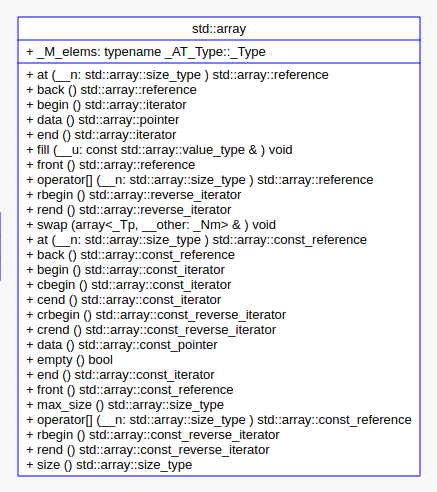
Comparing the arrays of tr1 and std
template<typename _Tp, std::size_t _Nm>
struct array
{
    typedef _Tp                           value_type;
    typedef value_type*               pointer;
    typedef const value_type*                       const_pointer;
    typedef value_type&                           reference;
    typedef const value_type&                     const_reference;
    typedef value_type*                       iterator;
    typedef const value_type*                 const_iterator;
    typedef std::size_t                           size_type;
    typedef std::ptrdiff_t                            difference_type;
    typedef std::reverse_iterator<iterator>       reverse_iterator;
    typedef std::reverse_iterator<const_iterator>   const_reverse_iterator;

    // Support for zero-sized arrays mandatory.
    typedef _GLIBCXX_STD_C::__array_traits<_Tp, _Nm> _AT_Type;    // # define _GLIBCXX_STD_C std
    typename _AT_Type::_Type                         _M_elems;
}
We find two notable places inside array:
// Support for zero-sized arrays mandatory.
typedef _GLIBCXX_STD_C::__array_traits<_Tp, _Nm> _AT_Type;    // # define _GLIBCXX_STD_C std
typename _AT_Type::_Type                         _M_elems;
Searching for __array_traits in the source code, we see:
template<typename _Tp, std::size_t _Nm>
struct __array_traits
{
    typedef _Tp _Type[_Nm];

    static constexpr _Tp&
    _S_ref(const _Type& __t, std::size_t __n) noexcept
    { return const_cast<_Tp&>(__t[__n]); }
};
The two lines of code above can be understood as the following:
In actual code, if we want to define an array, we can write:
Compared with tr1, the handling of the passed-in size is more complex: template partial specialization is used to handle the case where the passed size is 0.template<typename _Tp, std::size_t _Nm>
struct __array_traits
{
typedef _Tp _Type[_Nm];
static constexpr _Tp&
_S_ref(const _Type& __t, std::size_t __n) noexcept
{ return const_cast<_Tp&>(__t[__n]); }
};
template<typename _Tp>
struct __array_traits<_Tp, 0>
{
struct _Type { };
static constexpr _Tp&
_S_ref(const _Type&, std::size_t) noexcept
{ return *static_cast<_Tp*>(nullptr); }
};
Related Topics
- STL string deep dive | C++那些事
- STL string interview questions in depth | C++那些事
- STL deque source code analysis | C++那些事
- STL empty base optimization EBO | C++那些事
- STL hand-written hash table implementation | C++那些事
- STL hashtable hash table | C++那些事
- STL iterator source code analysis | C++那些事
- STL list source code analysis | C++那些事
- STL map and multimap | C++那些事
- STL queue and stack source code analysis | C++那些事