Last updated:2026-10-12
STL queue and stack source code analysis
0.Introduction
Why are stack and queue not called containers?
In this section we dive into the source code analysis with this question in mind.
1.stack
In the source code of stack we focus on two points:
- the default _Sequence is deque
- the internal function implementations call the corresponding functions of the _Sequence container.
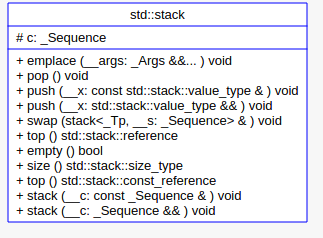
template<typename _Tp, typename _Sequence = deque<_Tp> >
class stack
{

public:
    typedef typename _Sequence::value_type                value_type;
    typedef typename _Sequence::reference                 reference;
    typedef typename _Sequence::const_reference           const_reference;
    typedef typename _Sequence::size_type                 size_type;
    typedef          _Sequence                            container_type;

protected:
    //  See queue::c for notes on this name.
    _Sequence c;

public:
     reference
      top()
      {
        __glibcxx_requires_nonempty();
        return c.back();
      }
    void
      push(const value_type& __x)
      { c.push_back(__x); }
}
Testing the underlying container of stack
For stack, the underlying container can be vector, deque, or list, but not map or set.
Since the compiler does not perform a comprehensive check, compilation fails only when a called function does not exist; so although something like set cannot serve as the underlying container, if it happens to have certain functions the calls still succeed — until a called function does not exist.
int test_stack() {
    cout<<"============test_stack============="<<endl;
    clock_t timeStart = clock();
    stack<int, list<int>> c;
    for (long i = 0; i < 100000; i++)
        c.push(i+1);
    cout << "stack.size()= " << c.size() << endl;
    cout << "stack.top()= " << c.top() << endl;
    c.pop();
    cout << "stack.size()= " << c.size() << endl;
    cout << "stack.top()= " << c.top() << endl;
    cout << "use stack milli-seconds : " << (clock() - timeStart) << endl;
    timeStart=clock();
    stack<int, deque<int>> c1;
    for (long i = 0; i < 100000; i++)
        c1.push(i+1);
    cout << "stack.size()= " << c1.size() << endl;
    cout << "stack.top()= " << c1.top() << endl;
    c1.pop();
    cout << "stack.size()= " << c1.size() << endl;
    cout << "stack.top()= " << c1.top() << endl;
    cout << "use stack milli-seconds : " << (clock() - timeStart) << endl;

    // vector可以作为stack的底层容器
    stack<int, vector<int>> c2;
    for (long i = 0; i < 100000; i++)
        c2.push(i+1);
    cout << "stack.size()= " << c2.size() << endl;
    cout << "stack.top()= " << c2.top() << endl;
    c2.pop();
    cout << "stack.size()= " << c2.size() << endl;
    cout << "stack.top()= " << c2.top() << endl;
    cout << "use stack milli-seconds : " << (clock() - timeStart) << endl;
}
2.queue
In the source code of queue we focus on two points:
- the default _Sequence is deque
- the internal function implementations call the corresponding functions of the _Sequence container.
template<typename _Tp, typename _Sequence = deque<_Tp> >
class queue
{
public:
    typedef typename _Sequence::value_type                value_type;
    typedef typename _Sequence::reference                 reference;
    typedef typename _Sequence::const_reference           const_reference;
    typedef typename _Sequence::size_type                 size_type;
    typedef          _Sequence                            container_type;

protected:

    _Sequence c;

public:

    void push(const value_type& __x)
    { c.push_back(__x); }

    void pop()
    {
        __glibcxx_requires_nonempty();
      c.pop_front();
    }
}
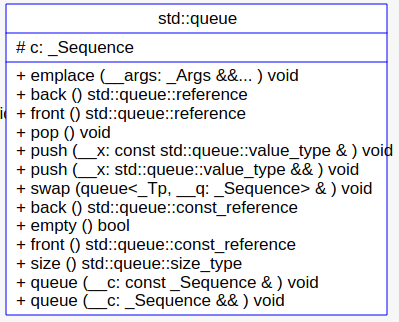
Similarly, the priority queue uses vector as its default container.
template<typename _Tp, typename _Sequence = vector<_Tp>,
typename _Compare  = less<typename _Sequence::value_type> >
class priority_queue
{
public:
    typedef typename _Sequence::value_type                value_type;
    typedef typename _Sequence::reference                 reference;
    typedef typename _Sequence::const_reference           const_reference;
    typedef typename _Sequence::size_type                 size_type;
    typedef          _Sequence                            container_type;

protected:
    //  See queue::c for notes on these names.
    _Sequence  c;
    _Compare   comp;

public:
    reference
    top()
    {
        __glibcxx_requires_nonempty();
        return c.front();
    }

    void
    push(const value_type& __x)
    {
        c.push_back(__x);
        std::push_heap(c.begin(), c.end(), comp);
    }

}
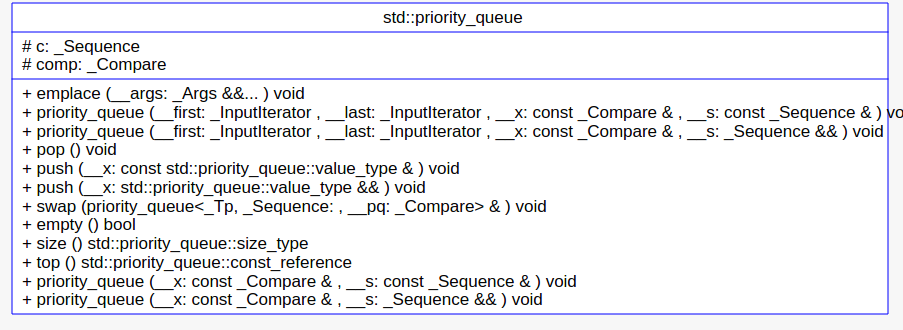
Test the underlying containers supported by these two container adaptors:
queue
For queue the underlying container can be deque or list, but not vector, map, or set; using the default deque is faster at insertion than other containers as the underlying one!
int test_queue() {
    cout<<"============test_queue============="<<endl;
    clock_t timeStart = clock();
    queue<int, list<int>> c;
    for (long i = 0; i < 100000; i++) {
        c.push(i+1);
    }
    cout << "stack.size()= " << c.size() << endl;
    cout << "stack.front()= " << c.front() << endl;
    c.pop();
    cout << "stack.size()= " << c.size() << endl;
    cout << "stack.front()= " << c.front() << endl;
    cout << "use list milli-seconds : " << (clock() - timeStart) << endl;

    timeStart=clock();
    queue<int, deque<int>> c1;
    for (long i = 0; i < 100000; i++) {
        c1.push(i+1);
    }
    cout << "stack.size()= " << c1.size() << endl;
    cout << "stack.front()= " << c1.front() << endl;
    c1.pop();
    cout << "stack.size()= " << c1.size() << endl;
    cout << "stack.front()= " << c1.front() << endl;

    cout << "use deque milli-seconds : " << (clock() - timeStart) << endl;
}
priority_queue
For the priority queue, tests show that using deque is faster at insertion than the default vector!
It supports vector and deque as the underlying containers, but not list, map, or set.
int test_priority_queue() {
    cout<<"============test_priority_queue============="<<endl;
    clock_t timeStart = clock();

    priority_queue<int, deque<int>> c1;
    for (long i = 0; i < 100000; i++) {
        c1.push(i+1);
    }
    cout << "stack.size()= " << c1.size() << endl;
    cout << "stack.top()= " << c1.top() << endl;
    c1.pop();
    cout << "stack.size()= " << c1.size() << endl;
    cout << "stack.top()= " << c1.top() << endl;

    cout << "use deque milli-seconds : " << (clock() - timeStart) << endl;


    priority_queue<int, vector<int>> c2;
    for (long i = 0; i < 100000; i++)
        c2.push(i+1);
    cout << "stack.size()= " << c2.size() << endl;
    cout << "stack.top()= " << c2.top() << endl;
    c2.pop();
    cout << "stack.size()= " << c2.size() << endl;
    cout << "stack.top()= " << c2.top() << endl;
    cout << "use stack milli-seconds : " << (clock() - timeStart) << endl;
}
Therefore, stack, queue, and priority_queue are not called containers; they are called container adaptors.
Related Topics
- STL array source code analysis | C++那些事
- STL string deep dive | C++那些事
- STL string interview questions in depth | C++那些事
- STL deque source code analysis | C++那些事
- STL empty base optimization EBO | C++那些事
- STL hand-written hash table implementation | C++那些事
- STL hashtable hash table | C++那些事
- STL iterator source code analysis | C++那些事
- STL list source code analysis | C++那些事
- STL map and multimap | C++那些事